

A fiber laser cutting machine lets you cut metal with incredible precision. You see the process start when the machine creates a powerful laser beam. The beam travels through fiber optic cables, then focuses onto the material. The intense light melts or vaporizes the metal, giving you clean, accurate cuts. Computer controls guide every move, so you get fast results and smooth edges. Compared to older cutting methods, you finish jobs quicker and need less maintenance.
Fiber laser cutting machines use a powerful laser beam guided through fiber optic cables to cut metal with high precision and speed.
Key parts like the laser source, cutting head, CNC system, and assist gas work together to deliver clean, accurate cuts on many materials.
The cutting process melts or vaporizes metal while assist gas removes molten material, improving cut quality and efficiency.
These machines offer fast cutting speeds, low maintenance, and can handle a wide range of metals and thicknesses.
Fiber laser cutting technology supports many industries by providing precise, versatile, and cost-effective metal cutting solutions.
A fiber laser cutting machine uses several key parts to deliver precise and efficient cuts. Each component plays a special role in the process. Here is a quick overview:
| Component | Function |
|---|---|
| Laser Source | Produces the powerful laser beam needed for cutting. |
| Fiber Optic Cable | Delivers the laser beam from the source to the cutting head while keeping the beam strong and focused. |
| Cutting Head | Focuses the laser onto the material and directs assist gas to the cutting area. |
| CNC System | Controls the movement and operation of the machine for accurate cuts. |
| Assist Gas | Helps remove melted material and protects the cutting area. |
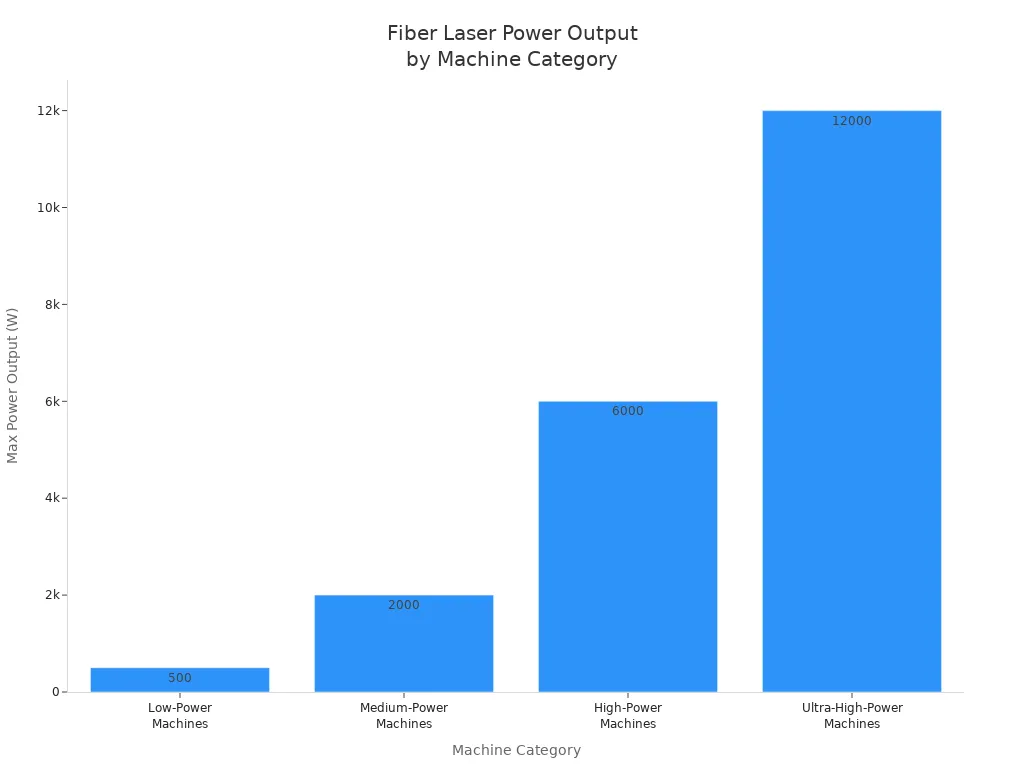
You find the laser source at the heart of every fiber laser cutting machine. It creates the laser beam that does the cutting. The core of the laser source is called the gain medium. This is a special fiber, often made from silica glass, that contains rare-earth elements like ytterbium. When you shine pump light into this fiber, it excites the atoms inside. These excited atoms release energy as a powerful, focused beam of light. This process is called optical pumping. The strength of the laser can range from a few hundred watts for thin materials to over 6,000 watts for thick, heavy-duty jobs.
The fiber optic cable carries the laser beam from the source to the cutting head. The core of this cable is made from high-quality silica glass. This material keeps the light inside the cable, guiding it with almost no loss. The cable also contains special elements that help create the right laser wavelength. You get a strong, clean beam at the cutting head, which is important for making accurate cuts.
The cutting head is where the action happens. It focuses the laser beam onto a tiny spot on the material. Inside, you find a focusing lens, a nozzle, and sensors. The lens makes the beam very small and powerful. The nozzle directs assist gas to the cutting area, blowing away melted metal. Sensors help keep the right distance between the head and the material, so you always get the best cut.
You control the fiber laser cutting machine with a CNC system. CNC stands for Computer Numerical Control. This system moves the cutting head and the workpiece with high accuracy. It reads your design files and turns them into instructions for the machine. The CNC system uses motors and sensors to make sure every cut matches your design, even for complex shapes.
Assist gas plays a big part in the cutting process. You can use different gases for different jobs. Oxygen helps cut thick steel quickly. Nitrogen gives you clean, shiny edges with no rust. Compressed air is a low-cost choice for some materials. The gas blows away melted metal and keeps the cutting area cool and clean.
You start the cutting process with laser generation. Inside the fiber laser cutting machine, pump diodes send energy into a special fiber called the gain medium. This fiber contains ytterbium, which helps turn the pump light into a powerful laser beam. The machine uses a laser generator to control the power and quality of the beam. Cooling systems, like water or air cooling, keep the laser stable and prevent overheating. The efficiency of this step depends on several factors, such as the purity of the gain medium, the stability of the laser source, and the cooling system’s performance.
Tip: Regular maintenance and calibration help you keep the laser source stable and extend the life of your fiber laser cutting machine.
Here is a table showing key aspects of laser generation and what affects its efficiency:
| Aspect | Description |
|---|---|
| Laser Generation Process | Uses ytterbium-doped fiber to convert pump light into a high-energy laser beam. |
| Key Components | Laser generator, laser head, control system, machine body. |
| Efficiency Factors | Power output, beam quality, cooling system, wavelength suitability, auxiliary components. |
| Cooling System | Water cooling for high power, air cooling for lower power; keeps output stable. |
| Beam Stability | Short-term fluctuations cause uneven cuts; long-term stability ensures accuracy. |
| Material Adaptability | Adjustable wavelength and beam parameters suit different metals and thicknesses. |
After the laser beam is generated, you need to deliver it to the cutting head. The fiber optic cable inside the fiber laser cutting machine carries the beam with almost no energy loss. The cable guides the beam from the source to the cutting head, keeping it strong and focused. Inside the laser source, beam combiners and amplifiers gather and boost the beam before it travels through the fiber optic delivery system. This setup ensures you get a clean, powerful beam at the cutting head.
The laser beam is generated by pump diodes.
Beam combiners and amplifiers boost the beam.
The fiber optic cable delivers the beam to the cutting head.
The cutting head contains focusing lenses.
Assist gases improve cutting efficiency and quality.
When the laser beam reaches the cutting head, you use a focusing lens to concentrate the beam onto a tiny spot on the material. The lens makes the beam very intense, which is important for precise cutting. High-quality focusing lenses create a small spot size and high energy density. This helps you achieve clean, accurate cuts with smooth edges. Autofocus systems can adjust the focus in real time, depending on the thickness and surface of the material. This keeps the beam perfectly focused and improves consistency.
Note: Clean and well-maintained focusing lenses help you keep the cutting quality high and reduce the risk of rough edges or burrs.
You remove material by melting or vaporizing it with the focused laser beam. The energy from the beam heats the metal until it melts or turns into vapor. The main mechanism for removing material is the force of the assist gas, which blows the molten metal away from the cut. The thickness and type of material affect how much power you need and how fast you can cut. Highly reflective metals, like copper and brass, need special settings and higher power. Less reflective metals, such as carbon steel and stainless steel, absorb the laser better and are easier to cut.
Here is a table showing how different factors affect material removal:
| Aspect | Description |
|---|---|
| Material Removal Mechanism | Laser melts metal; assist gas blows away molten material. |
| Melt Pool Dynamics | Melt pool forms and expands; flow behavior affects removal efficiency. |
| Influencing Parameters | Laser power, cutting speed, gas pressure, focal plane position. |
| Material Differences | Reflectivity, thickness, and composition affect absorption and removal. |
| Assist Gases | Oxygen speeds cutting but oxidizes edges; nitrogen prevents oxidation for cleaner cuts. |
| Thickness Effects | Thicker materials need more power and slower speeds. |
| Quality Improvement | Higher removal rates reduce rough edges and improve cut quality. |
Assist gas plays a key role in the fiber laser cutting machine. You use gases like nitrogen, oxygen, or compressed air to blow away molten material and keep the cutting area clean. Nitrogen prevents oxidation and gives you shiny, clean cuts. Oxygen speeds up cutting, especially for thick materials, but may cause oxidation on the edges. Compressed air is a cost-effective choice for mild steel and stainless steel.
| Assist Gas | Influence on Quality | Influence on Speed | Additional Notes |
|---|---|---|---|
| Nitrogen | Prevents oxidation, produces clean, shiny cuts | Enables faster cutting speeds | Ideal for precise cuts; improves efficiency and lowers costs |
| Oxygen | May cause oxidation and carbon layer on cut edge | Increases cutting speed for thick materials | Reactive gas; enhances laser power but can affect edge quality |
| Compressed Air | Efficient and economical; suitable for mild steel | Good cutting speed; widely available and low cost | Alternative when oxygen and nitrogen supply is limited |
Remember: The choice of assist gas depends on the material, thickness, and quality you want. Using the right gas helps you get better results and saves time.
You get outstanding precision with a fiber laser cutting machine. The laser can cut with tolerances as tight as ±0.001 inches, or about ±25 micrometers. This level of accuracy lets you create intricate designs and detailed parts. The focused laser beam produces clean edges and sharp corners, even on thin sheet metal. You can rely on repeatable results, which means every part matches your design.
High precision and accuracy for tight tolerances
Minimal heat-affected zone, reducing distortion
Ability to cut complex shapes and fine details
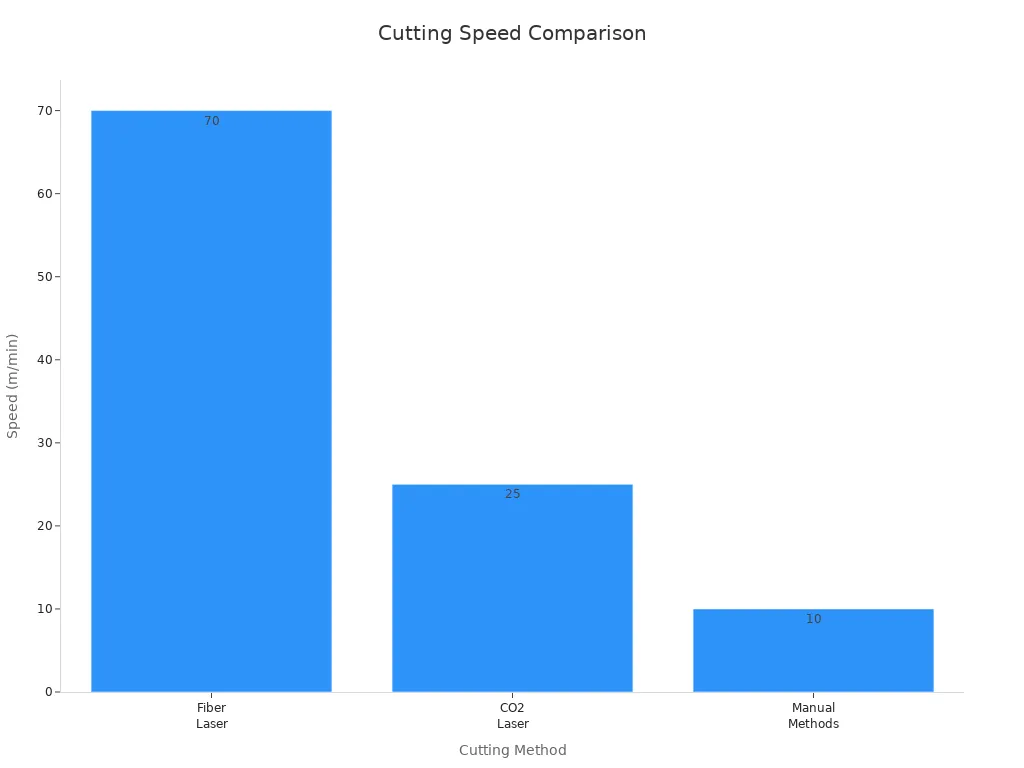
Fiber laser cutting machines work much faster than traditional cutting methods. You can cut thin materials at speeds up to 55 meters per minute with a 6kW laser. Higher power machines, like 12kW or 20kW, cut even thicker metals at impressive speeds. This efficiency helps you finish jobs quickly and reduces production time.
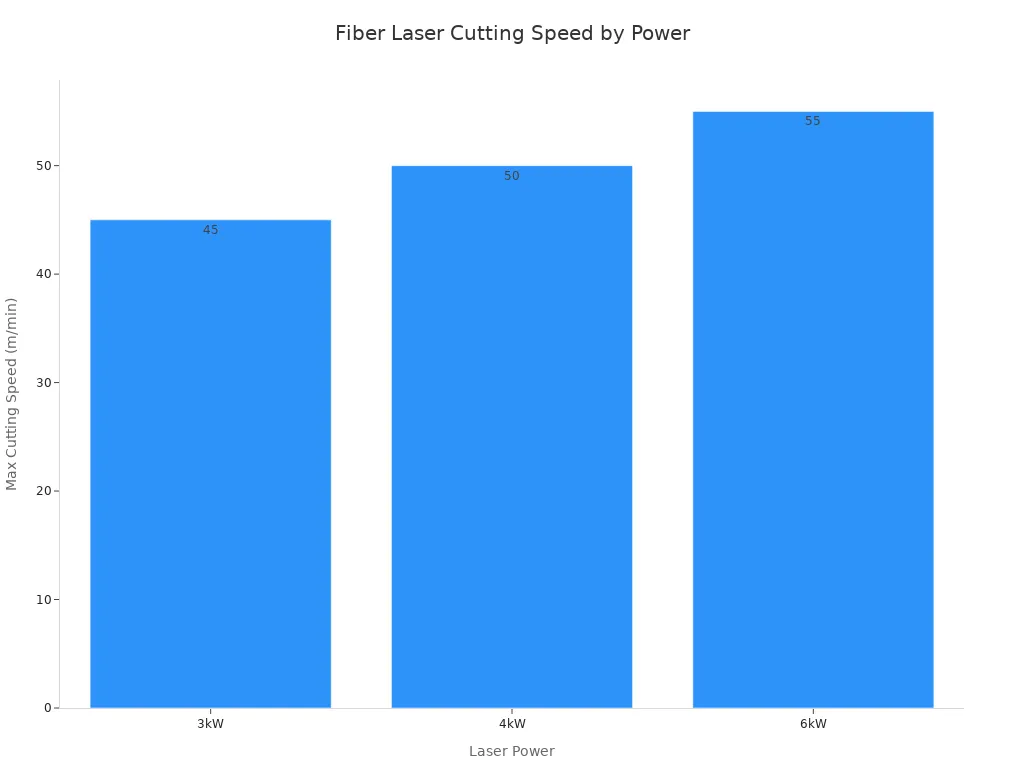
| Laser Power | Max Material Thickness (mm) | Max Cutting Speed (m/min) |
|---|---|---|
| 3kW | Up to 20 | 30-45 |
| 4kW | Up to 25 | 40-50 |
| 6kW | Up to 30 | 45-55 |
You can use fiber laser cutting machines on many types of materials. These machines handle carbon steel, stainless steel, aluminum, copper, brass, titanium, acrylic, and composite materials. You can cut thick or thin sheets, and the machine adapts to different jobs easily.
Works on a wide range of metals and some non-metals
Handles material thicknesses from thin sheets up to 70 mm for stainless steel
Cuts reflective metals like copper and brass, which are hard for other lasers
You spend less time and money on maintenance with fiber laser cutting machines. The design has fewer moving parts and no mirrors in the laser source. You only need to check and clean the lens and nozzle daily, and replace protective lenses when needed. Consumables like lenses and nozzles are inexpensive. The machine uses less power and has lower operating costs compared to CO2 lasers.
Simple daily checks and cleaning
Lower annual maintenance costs (about $200–$400)
Fewer consumables and less downtime
Tip: Regular care keeps your machine running smoothly and extends its life.
You can use fiber laser cutting machines for a wide range of metal cutting tasks. These machines handle carbon steel, stainless steel, aluminum, copper, and brass with ease. You get clean, precise cuts on both thin and thick sheets. Many industries rely on fiber lasers to cut parts for machinery, tools, and custom metalwork. You can create everything from simple brackets to complex artistic designs. Job shops and metal fabrication businesses use fiber lasers to fill custom orders, make prototypes, and produce parts in large quantities.
Cut thick steel frames for construction equipment
Shape aluminum panels for various products
Produce detailed metal signs and decorative pieces
Fiber laser cutting gives you flexibility and speed, making it a top choice for metalworking.
You see fiber laser cutting machines everywhere in the automotive industry. These machines help you cut chassis parts, body panels, exhaust systems, and battery components with high precision. You can process complex shapes and multi-material assemblies, including high-strength steel and aluminum. Integration with CNC and robotic systems lets you automate cutting and welding, which boosts efficiency and quality.
Cut and trim doors, frames, and cooling system parts
Weld and mark components for traceability and strength
Process both mass production and custom vehicle parts
Laser cutting reduces waste and supports lighter, safer vehicle designs. You also save space because these machines fit easily into production lines.
You use fiber laser cutting machines to make many electronic components. These machines cut printed circuit boards (PCBs), connectors, and enclosures with micro-level accuracy. You get burr-free edges and can handle complex patterns, which is important for smartphones, computers, and other devices. Fiber lasers work well with metals like copper, brass, and aluminum, as well as plastics and acrylics.
Shape intricate circuit patterns on PCBs
Fabricate precise enclosures for electronic devices
Create small, detailed connectors and parts
The precision of fiber lasers helps you meet the high standards of the electronics industry.
Fiber laser cutting technology benefits many other fields. You find these machines in medical device manufacturing, jewelry, advertising, construction, agriculture, energy, and shipbuilding.
| Industry | Typical Applications |
|---|---|
| Medical Devices | Surgical tools, custom implants, dental appliances |
| Jewelry | Cutting gold, silver, platinum for custom designs |
| Advertising & Signage | Metal signs, decorative elements, sculptures |
| Construction & Architecture | Structural beams, facades, railings, gates |
| Agriculture | Tractor parts, gears, blades, brackets |
| Energy | Oil and gas equipment, wind turbine and solar panel parts |
| Shipbuilding | Large metal sheets for hulls, structural ship parts |
You can see how fiber laser cutting supports innovation and quality across many industries.
You see how each part of a fiber laser cutting machine works together to give you fast, clean, and accurate cuts. The table below shows why this technology stands out:
| Benefit | What You Gain |
|---|---|
| High Speed | Faster production and less waiting |
| Precision | Clean edges and detailed shapes |
| Versatility | Cuts many metals and complex designs |
| Low Maintenance | Less downtime and lower costs |
| Energy Efficiency | Saves power and helps the environment |
Understanding how these machines work helps you make smart choices, improve quality, and stay ahead in your industry.
You control the machine with a computer. The laser focuses on a tiny spot. Sensors help keep the right distance. You get sharp edges and smooth shapes every time.
Tip: Clean lenses and regular checks help you keep your cuts accurate.
You can cut carbon steel, stainless steel, aluminum, copper, brass, and some plastics. The machine works well on thin and thick sheets.
| Material | Can Cut? |
|---|---|
| Carbon Steel | ✅ |
| Aluminum | ✅ |
| Copper | ✅ |
| Plastics | ✅ |
You learn basic safety and machine controls quickly. Most machines have easy-to-use software. You follow instructions and practice to get better results.
Watch safety videos
Read the manual
Practice with simple shapes
You pick nitrogen for clean edges. Oxygen works best for thick steel. Compressed air saves money on mild steel. The right choice depends on your material and the finish you want.
Note: Always check the gas type before you start cutting.

